Now Reading: Bible Journaling: Beginner’s Guide and 40 Page Ideas
-
01
Bible Journaling: Beginner’s Guide and 40 Page Ideas

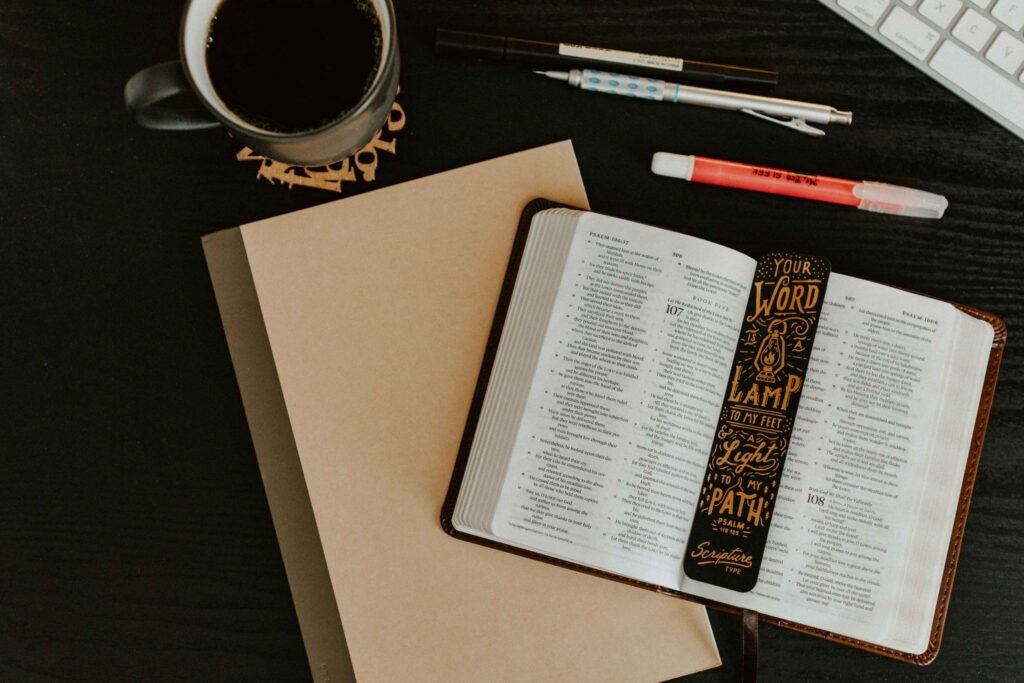
Bible journaling means responding to a Bible passage in your own way, like writing notes, asking questions, praying, or drawing. To start, read a short passage, write down the reference, and then jot down one observation and one response in your notebook or in your Bible’s margin.
You don’t need fancy lettering skills or a special Bible. Just a pencil and some regular paper are enough. The 40 Bible journaling ideas below offer different ways to spend time with eight passages, so you can choose a format that helps you focus on what you’re reading.

What is Bible journaling?
Start with Scripture. Read it, notice something that stands out, and then make a written or visual response. Your page could have a question about a character, a short prayer, a diagram of the story, or a carefully noted quotation.
Bible Gateway’s Scripture Engagement resource, created with Taylor University’s Center for Scripture Engagement, lists several places you can journal: in the Bible margin, on a sketchpad, in a journal, or in a binder. It also suggests writing and drawing as ways to respond. Check out their journaling practice tips.
A general journal will contain thoughts on anything that happened during the day. A Bible journal will have a particular passage linked to your thoughts. You could use the same notebook for both, just date and reference the entries to tell them apart. Our daily journal prompts are there to give you a starting point for the more general type of entry.
Do you need a journaling Bible?
You can use the Bible you already have and keep your notes in a separate notebook. This gives you plenty of space and keeps your Bible’s pages clean. It also lets you try out different layouts before deciding if you want to write directly in your Bible.
If you want to write notes in the margins, look for a Bible with wide margins, easy-to-read font, and paper that suits your materials. Always check the specific edition, since not all journaling Bibles have the same paper or layout.
Different people and churches have their own ways of marking up a Bible. It’s fine to pick a format that works for you. You might keep your artwork in a separate journal, and you should never write in a Bible that belongs to someone else without their permission.
A beginner supply list with price ranges
Begin with supplies you already have. The US dollar amounts listed are just suggested budgets, and prices may vary by store. Remember, tax and delivery costs are extra.
| Supply | Suggested allowance | What to choose first |
| Bible | $0 using an existing copy | A translation you can read comfortably |
| Separate notebook | $1–$5 | Enough space for a reference, notes, and a response |
| Pencil or familiar pen | $0 using one you own; up to $5 if buying | A comfortable writing tool; test ink on matching paper |
| Small colored-pencil set, optional | $2–$6 | A few colors you will use; apply light pressure |
| Ruler, optional | $0 using one you own; up to $3 if buying | A straight edge for boxes and columns |
| Decorative extras, optional | $0–$5 total | Add only after you know what your pages need |
For two price references, Target listed an up&up flexible-cover composition notebook at $1.49 and a Crayola 12-count colored-pencil set at $2.19 when checked on November 20, 2026. Together, those examples total $3.68 before tax, using an existing Bible and pencil. Prices and availability can change.
As you learn, keep wet paint, strong markers, and glue experiments on separate sheets of paper. Product labels can’t always predict how materials will react on your Bible’s pages. If possible, test your tools on similar paper, let it dry, and check both sides. If you want to avoid changing your Bible pages, just use a separate notebook.
How to start Bible journaling in five steps
1. Read a complete short passage
Begin with a paragraph, a short psalm, or a complete story. Make sure to read the surrounding text, not just a single sentence that fits your design.
Ask yourself who is speaking, who they’re talking to, and what’s happening. Poems, parables, and letters each need different questions as you read.
2. Record the reference and translation
Write down the book, chapter, verse, date, and translation abbreviation. If you copy words directly, use quotation marks and double-check them. Mark your own summaries clearly so you don’t mix them up with Scripture later.
3. Notice something specific
Pick out a repeated word, an action, an image, or a contrast. Write down what you notice before moving on, and think about what it might mean for your day.
If you have an unanswered question, write it on the page. You can return to it later with a study resource or talk it over with a pastor, teacher, or study group.
4. Choose one response
Write a prayer, draw a small scene, make a list, or jot down an action you want to think about. Leave space to connect your response to the passage. You can decorate it later if you want.
5. Finish at a manageable point
A reference, two observations, and a question make a complete entry. Add the date, and you’re done. Our guide to building a journaling habit offers practical tips for fitting short entries into your daily routine.
40 Bible journaling ideas for your pages
Each group below has five original page designs for one passage. You can choose one design now and try another later. There’s no need to do all five pages or follow the list in order.
The passages listed are from the King James Version, but you can read them in any translation you prefer. The instructions and reflection questions below are original prompts, not direct quotes from the Bible.
Creation and attention: Genesis 1
Read Genesis 1 before choosing a design.
- Six-panel sequence. Divide a notebook page into six boxes. Summarize each day’s events with a small drawing and its verse references.
- Light-and-dark border. Use two pencil shades beside your notes on verses 1–5. Keep the text readable and record what is separated and named.
- Repeated-phrase study. Make a tally of a repeated phrase. Note where it occurs and what its repetition contributes to the chapter.
- Living-things collection. Draw simple plants, birds, and fish beside references to their creation. Add a question about how you respond to the world described.
- Human dignity reflection. Beside verses 26–27, write a question about what being made in God’s image means for how you treat another person.
Guidance and presence: Psalm 23
Read the whole of Psalm 23, including its difficult landscape and its images of welcome.
- Landscape strip. Sketch pasture, water, a path, and a valley. Place verse references beneath the images rather than trying to illustrate every word.
- Shepherd image study. Write what the shepherd does in the psalm. Separate those observations from your questions about guidance.
- Valley prayer. Draw a small dark band across the page for verse 4. Write an honest prayer without requiring yourself to make the page cheerful.
- Table scene. Sketch the table and cup in verse 5. Note who is present in the verse and what questions the scene raises.
- Movement diagram. Use arrows to trace changes in setting through the psalm. End with a brief reflection on its closing image of dwelling.
Thanks and worship: Psalm 100
Read Psalm 100, then choose a written or visual response.
- Action-word page. List the actions the psalm invites. Add a small symbol beside each, with the relevant verse number.
- Five-verse accordion. Fold separate paper into five sections, one per verse. Write a short summary in each and keep the insert in your notebook.
- Thanksgiving doorway. Draw a doorway around notes on verse 4. Write a few specific things you want to include in a prayer of thanks.
- Community circle. Around notes on verse 3, record questions about the psalm’s collective language. Consider how communal worship differs from a private reflection.
- Closing-verse lettering. Copy a short portion of verse 5 from your chosen translation. Add the reference, translation, and a question about its meaning.
For more ways to move from broad thanks to specific details, our gratitude journal prompts can support a separate reflection alongside your reading.
Jesus’ teaching: Matthew 5:1–16
Read Matthew 5:1–16. Notice the setting before making a page about one image or teaching.
- Teaching-scene sketch. Draw a simple hillside and note who approaches Jesus in verses 1–2. Record a question about the audience.
- Beatitudes chart. Make two columns: the people described and what Jesus says about them. Use summaries or carefully labeled quotations.
- Mercy reflection. Focus on verse 7. Describe one situation in which you want to understand mercy more clearly, without sharing another person’s private information.
- Peacemaking question page. Place a question about verse 9 in the center. Leave space for later notes from a study resource or conversation.
- Lamp illustration. Sketch the lamp image in verses 14–16. Add a practical reflection on good works and whom the passage says they should glorify.
A neighbor’s actions: Luke 10:25–37
Read the conversation and parable in Luke 10:25–37, including Jesus’ closing question.
- Question-and-answer map. Trace the questions asked by the lawyer and Jesus. Use arrows to show how the conversation develops.
- Story sequence. Make four simple panels: the attack, those who pass by, the Samaritan’s response, and care at the inn. Label the references.
- Compassion in verbs. List the Samaritan’s actions in verses 33–35. Note how the story makes compassion concrete.
- Resources page. Draw small symbols for transport, supplies, money, and time used in the story. Reflect on a realistic form of help you could offer.
- Closing-question foldout. Put Jesus’ final question on a paper flap and your response underneath. Keep a distinction between the text and your application.
Everyday relationships: Romans 12:9–21
Read Romans 12:9–21 as a connected set of instructions rather than isolated slogans.
- Instruction grid. Group observations under love, hospitality, shared feelings, and responses to hostility. Add verse references to each group.
- Hospitality note. Beside verse 13, write an idea for welcoming or helping someone that fits your actual time and resources.
- Shared-emotions spread. Make two panels for verse 15. Reflect on listening when another person is celebrating and when they are grieving.
- Limits and responsibility. Copy verse 18 accurately, including its qualifications. Write a question about your responsibility and what you cannot control.
- Response choices. Draw two branching paths beside verses 17–21. Use them to reflect on the contrast between retaliation and responding with good.
Prayer and practice: Philippians 4:4–9
Read Philippians 4:4–9. Approach the page as a response to the passage, without grading your feelings.
- Prayer-and-thanks columns. Give a concern and a specific thanksgiving separate spaces. Use verse 6 as the reference for the layout.
- Verse connections. Draw lines between prayer, thanksgiving, peace, attention, and practice. Note which verses led you to each connection.
- Attention wheel. Divide a circle into sections for the qualities named in verse 8. Add one concrete example or question in each.
- Practice card. On a separate index-sized piece of paper, note one response to verse 9. Keep it with the page and revisit it later.
- Unresolved-question page. Write a question about the relationship between prayer and worry. Leave room to explore it without forcing an immediate answer.
Listening and doing: James 1:19–27
Read James 1:19–27, following the movement from listening to action.
- Three-part speech reflection. Make three spaces for listening, speaking, and anger in verse 19. Record an observation before adding a personal response.
- Hear-and-do chart. Put what you notice in one column and a possible action in another. Keep the verse 22 reference visible.
- Mirror diagram. Draw a simple mirror beside verses 23–25. Explain the comparison in your own words, then note a question.
- Words to actions. Use a speech bubble for notes on verse 26. Reflect on how words and conduct connect in the passage.
- Care with follow-through. Beside verse 27, write a question about supporting people in difficulty. Note one way to learn what help is actually wanted.
A simple first-page example
For the first session, Psalm 23 and idea 7. On a separate notebook page, write the date, reference and translation. On the same page draw three small boxes labeled Observation, Question and Response.
In the Observation box, write that the shepherd image shows leading and restoring. In the Question box, jot down something you want to explore about that image. In the Response box, write a short prayer or your honest reaction to the reading.
This layout is just an example, not a personal story. You can make a similar page without drawing any pictures. If your Bible margin is small, just write the reference and a question there, and put the full entry in your notebook.
How do you keep the passage in context?
On your page, separate what the passage says, what you think about it, and how you respond. Use different headings or colors if that helps you. Your personal connection can matter, even if it’s not the main message of the passage.
Look at the verses around the one you’re focusing on before you see it as a promise for your own life. If you’re unsure about what it means, write down your question and ask a trusted study resource or someone knowledgeable in your faith community.
If you share your page, make sure to note which translation you used for any quotes and check if you need permission from the publisher. Keep other people’s names and details private unless they’ve agreed to share them.
Common beginner questions
Is it alright to journal without drawing?
Yes. Writing questions, notes, prayers, or making diagrams are all good ways to respond. How much you decorate your page doesn’t show how carefully you’ve read.
What if the ink shows through the page?
If ink shows through, start your next entry in a different notebook and test your materials before using them again. Every paper and tool is different. Don’t try to fix a thin page with more wet material or glue until you know how it will react.
How often should you do Bible journaling?
Pick a journaling routine that fits your life and reading habits. You could journal after reading once a week, or just jot down notes when a passage stands out. The 40 ideas are options, not daily tasks.
Can you include the difficult feelings or doubts?
You can be honest about how you feel and leave some questions open. Not every entry has to be cheerful. Just keep your private writing somewhere you feel comfortable, especially if you use a shared device or notebook.
Bible journaling is meant to support your reading and faith, but it’s not a substitute for professional mental health care. If journaling causes you ongoing distress, stop and get the right support. A spiritual leader can help with faith questions, and a health professional can help with mental health concerns.
For your first page, pick a short passage, write one question, and use a tool you already have. Leave some space for anything you notice in the future.
Sources and reference notes
- Bible Gateway and Taylor University Center for Scripture Engagement: Journaling Scripture Practice Tips
- The eight Scripture passages are linked beside their respective idea groups. References were checked against the King James Version; summaries, layouts, and prompts are original editorial material.
- Target: up&up flexible-cover composition notebook—$1.49 when checked November 20, 2026
- Target: Crayola 12-count pre-sharpened colored pencils—$2.19 when checked November 20, 2026

Hi, I’m Brittany Larsen, a passionate blogger and content creator dedicated to writing meaningful and engaging articles. I specialize in topics like mental health, wellness, and personal development, aiming to inspire and empower my readers through relatable stories and practical advice.