Now Reading: Chest Exercises with Dumbbells: 9 Moves for a Full Chest Workout
-
01
Chest Exercises with Dumbbells: 9 Moves for a Full Chest Workout
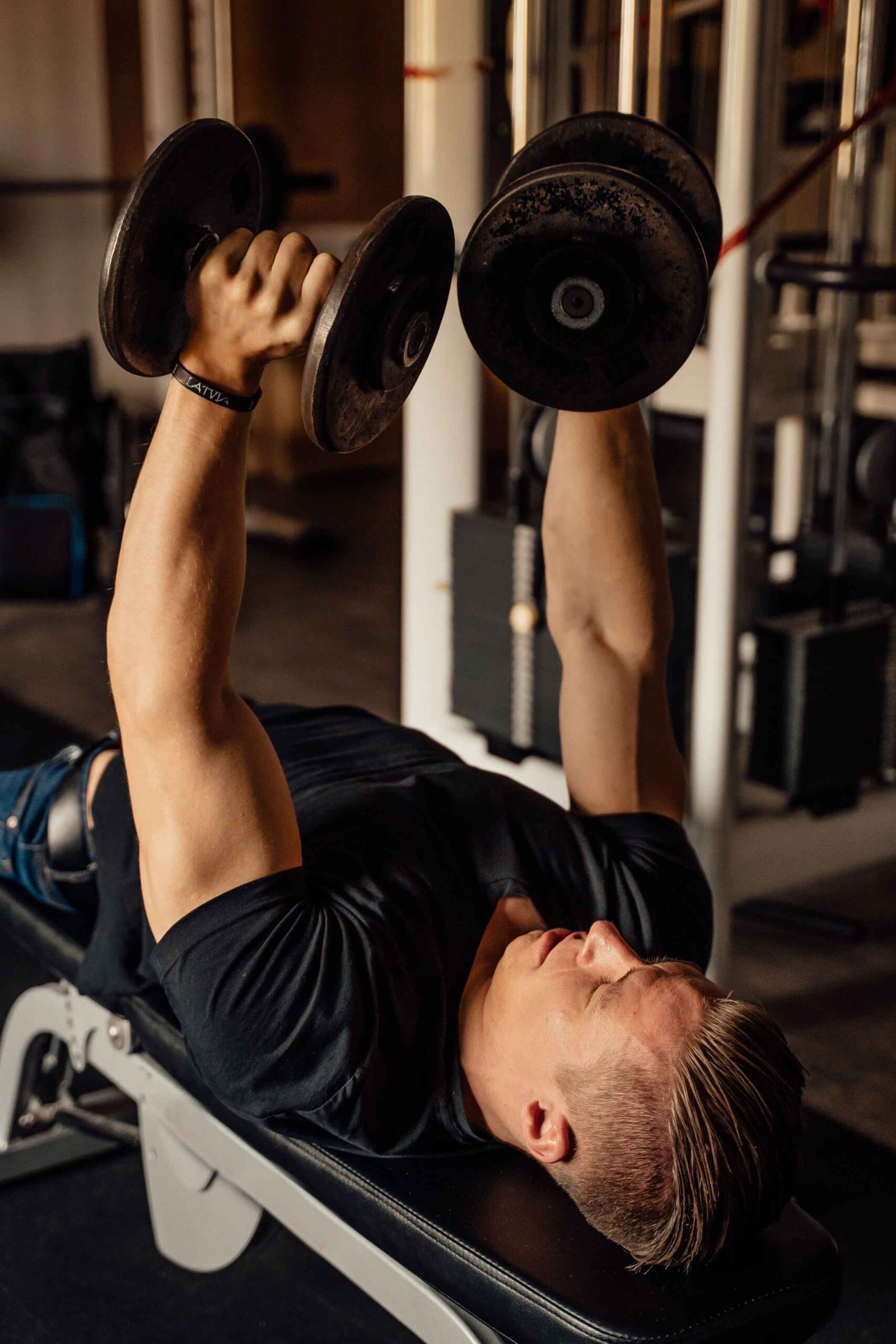
With just a pair of dumbbells, you have plenty of ways to work your chest, like flat presses, incline presses, floor presses, and lighter fly variations. Below, you’ll find nine dumbbell chest exercises to choose from, plus a sample workout with sets, reps, and rest times.
You don’t have to try all nine exercises at once. Start by learning one press, and add another movement when you feel comfortable handling the weights from start to finish.
If you’re building your first routine, our beginner gym workout is a four-week plan for your whole body. The chest exercises included will help you choose a dumbbell alternative when you’re ready.
Which dumbbell chest exercises should you do?
Think about your equipment and experience. A flat bench gives you good support for pressing, while an adjustable bench lets you try incline moves. If you don’t have a bench, use the floor press instead of balancing on furniture.
| Exercise | Equipment beyond dumbbells | What changes |
| Flat dumbbell bench press | Flat weight bench | Both arms press together |
| Incline dumbbell press | Adjustable weight bench | Your torso sits at an incline |
| Neutral-grip dumbbell press | Flat weight bench | Palms face each other |
| Dumbbell floor press | Clear floor space; optional thin mat | The floor limits how far the upper arms descend |
| Single-arm dumbbell bench press | Flat weight bench | One side works while you resist turning |
| Alternating dumbbell bench press | Flat weight bench | Arms take turns moving |
| Flat dumbbell fly | Flat weight bench | Arms move in a wide arc with little elbow movement |
| Incline dumbbell fly | Adjustable weight bench | The fly is performed with your torso inclined |
| Dumbbell pullover | Flat weight bench | Arms travel overhead rather than out to the sides |
Some of these exercises are just different versions of the same basic movement. The goal is to give you options, not to make your workout list longer.
Before you pick up the weights
Start with five to ten minutes of light aerobic activity to warm up, then practice your first press using light dumbbells. Mayo Clinic suggests warming up, lifting with control, and breathing out as you lift instead of holding your breath. Check out their weight-training tips for more details.
Pick a weight you can lift into position and put down safely. Ask a qualified trainer to show you how to set up and finish, and use a spotter if needed. If you struggle to start or finish, use a lighter weight.
Make sure your weight bench is sturdy and the adjustment is locked. Hold the handles with your fingers closed, and keep your wrists straight. When using the bench, support your head, upper back, and hips, and keep your feet firmly on the floor.
9 chest exercises with dumbbells
1. Flat dumbbell bench press
This is a simple way to learn the dumbbell press.
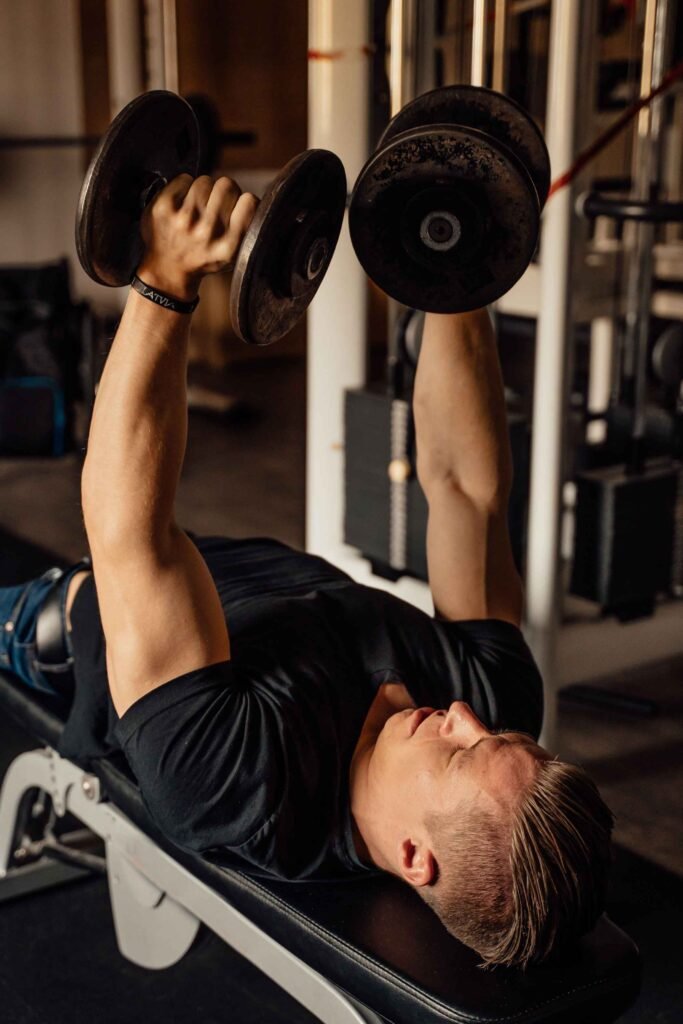
Lie on a flat bench with the dumbbells above your chest. Lower them together, keeping your wrists over your elbows and your upper arms at a comfortable angle to your torso. Press back up smoothly, without knocking the weights together.
Keep your shoulders supported and avoid bouncing at the bottom. Only lower the weights as far as you can control without shoulder discomfort. You don’t need to go as deep as possible. The ACE chest press demo shows the right position and movement.
2. Incline dumbbell press
Set your adjustable bench to an incline and make sure it’s secure. Use lighter weights than you would for a flat press until you get used to the new position.
With your back supported, lower the dumbbells down towards the sides of your upper chest. Keep your forearms under the weights and then press up, without sliding down the bench or lifting your hips.
If you need to arch your back a lot to finish, stop the set and use a lighter weight. Ask a trainer to help you choose a bench angle that feels right for you. ACE’s incline press guide shows the exercise on a bench set between 45 and 60 degrees.
3. Neutral-grip dumbbell press
Use the flat press setup but turn your palms towards each other. Maintain that orientation as you lower and press, with your elbows moving in towards your sides.
This grip gives you another option if it feels more comfortable. It’s not meant to treat shoulder pain. Keep some space between the dumbbells instead of pressing them together, and use the same controlled depth as with a regular press.
4. Dumbbell floor press
The floor press lets you work out without a bench. Lie on your back with your knees bent and feet flat, holding the dumbbells above your chest.
Lower the weights until your upper arms gently touch the floor, then press back up. Don’t bounce your elbows or use your hips to lift the weights. The floor gives you a clear stopping point, so the movement is shorter than with a bench press.
Mayo Clinic lists the floor as an option in its dumbbell chest press demo. Make sure the movement feels comfortable and the weight is manageable. Using the floor doesn’t make it okay to press through pain.
5. Single-arm dumbbell bench press
Save this variation until you can perform the press with both arms without shifting around on the bench. One dumbbell creates an uneven load so keeping your torso absolutely still becomes part of the exercise.
Begin with a light weight in one hand and keep your feet firmly on the floor. Press and lower on that side while supporting both shoulders and hips. Finish your reps, then switch sides safely.
If your body is rolling or you need to grip the bench quite hard to stay in place, then go back to the two arm press. NASM’s single arm press guide describes this as an advanced variation which requires a great deal of trunk control.
6. Alternating dumbbell bench press
Start with both dumbbells above your chest. Lower one weight whilst holding the other steady, press the other one back up and then switch arms. Complete one side before you start the other.
Use the lighter weights when you’re working through the sequence. The stationary arm has to be well controlled and your torso must not rock side to side.
Count repetitions per arm: eight per side means eight presses with each arm. NASM identifies alternating arm pressing as the next progression on from two arm pressing in its beginner training guidelines.
7. Flat dumbbell fly
A fly uses a longer arm position than a press so you’ll need to start much lighter. Hold the weights above your chest with your palms facing each other and your elbows quite slightly bent.
Open your arms out in a wide arc, stop at a comfortable depth (no lower than shoulder height) and then bring the weights back together along the same path. Keep the bend in your elbows pretty much constant rather than turning the return into a press.
Don’t go chasing after a deep stretch. The ACE lying chest fly guide will show you the movement and the supported position. Flies are optional really, you can quite easily build a routine around the presses as you’re learning.
8. Incline dumbbell fly
This is a variation that incorporates an inclined torso with the fly’s wide arm path. Bench is secured, back is against the bench and you start with very light dumbbells above your chest.
Open your arms with a small steady elbow bend and then bring them back together. Keep your hips on the seat and stop well before your shoulders roll forward or your back arches to get any extra range.
Learn the flat fly first. Changing the bench angle is a reason to go back and reassess your load and your comfortable depth, not an excuse to keep on lowering until you’re in the same position as you were before.
9. Dumbbell pullover
The pullover uses an overhead arm path and can be used as an optional accessory after pressing. It’s not at all necessary to do a complete beginner chest workout.
For the two-dumbbell version, lie lengthwise on a flat bench with your head, back, and hips on the bench. Start with the weights above your chest, palms facing each other. Move your arms slowly overhead as far as you can without lifting your ribs or arching and then return.
Keep a small steady elbow bend and don’t go in for repeated elbow bends. Omit this option if overhead movement is uncomfortable. ACE’s lying pullover demo shows the two dumbbell version.
A sample chest workout with dumbbells
Once you’re comfortable with the basic pressing, this sample gives you two presses and one optional accessory. It’s an example to get you to adjust to your own ability, not a prescription for you.
Warm-up sets are not included in the working sets below. Complete each working set whilst you can still do about two more controlled reps.
| Order | Exercise | Working sets | Repetitions per set | Rest between sets |
| 1 | Flat dumbbell bench press | 2 | 8–12 | 2 minutes |
| 2 | Incline dumbbell press | 2 | 8–12 | 2 minutes |
| 3 | Flat dumbbell fly, optional | 1 | 10–15 | 90 seconds before starting, if needed |
That’s four working sets without the fly (or five with it). Take the listed rest before moving on to the next exercise and allow longer if you need to in order to get back to a state of control and steady breathing.
For your first few sessions just learn one press for one or two working sets and save the other exercises for later. You don’t have to start with the entire table.
No bench: do the floor press for one or two sets of 8-12 controlled reps, with 2 minutes rest. Just get used to it rather than trying to simulate the incline movements on a sofa or a stack of cushions.
Within an existing routine: work out the amount of chest work you’re already doing. If your plan already has push ups or machine presses in it then simply substitute an appropriate dumbbell press for that. Don’t go and add the whole of this workout on top.
How often should you train your chest?
Two non-consecutive training days can be a perfectly viable starting point (e.g. Monday and Thursday). You’ll need to leave at least a full day between any two sessions that work the same muscles and of course you’ll need to adjust your schedule if you’re still too sore to move around properly.
ACSM’s 2026 resistance training guidance stresses that you should be working all of the major muscle groups at least twice per week with the programme being individualised. It also states that training to muscle failure is not necessarily required for the average healthy adult. See the ACSM update.
Plan your pulling and lower-body exercises alongside chest work. Our three-day full-body workout shows how pressing can fit into a wider weekly routine. You don’t need a separate chest day to use dumbbells effectively.
How to choose a weight and make progress
Your first weight should allow you to finish the lower end of the rep range with steady wrists, a controlled lowering and no twisting at all. If your technique starts to fall apart before you’ve done eight reps, then try a lighter pair.
Record the exercise, the bench setting, the weight per dumbbell, the sets and the reps. “Flat press: 5kg each, 10 and 9 reps” is a lot more informative than simply “chest day done”.
A simple progression rule for this sample is to stay at the same weight until you hit the top of the range on every planned set for two sessions, with control and reps in reserve. Then go for the smallest possible increase and work back down towards the lower end of the range. If that increase is too big then just keep working at your current weight.
Add repetitions or load before you go on to add several more exercise variations. Change just one thing at a time so you can see how you respond.
Common questions
Can you build your chest with just dumbbells?
Dumbbells can be used for chest work without a barbell. What’s important is having an appropriate exercise, sufficient challenge for your current ability and a repeatable plan. Eventually a very light fixed pair will probably become a limiting factor and more variations won’t necessarily get you over that hurdle.
Should you do all nine exercises?
No. A lot of people will do the same pressing or fly pattern with a different grip, a different bench position or a different arm sequence. Just pick the movements you can do well and just keep repeating them until you start to see progress. The sample workout only has three.
How many calories does a dumbbell chest workout burn?
There isn’t a single number for this routine. Your body size, effort, session length, and rest periods affect the estimate. Our guide to strength-training calories burned explains how those estimates vary. Use your workout log to assess lifting progress rather than trying to reach a watch’s calorie target.
What if your shoulder’s hurting you when you’re doing the presses or the flies?
Stop the painful movement. Don’t go on forcing more depth, don’t switch grips all the time in the hope that you’ll ‘push through’ it, and don’t assume that pain is a sign that the exercise is working. A qualified trainer can check your technique. If you’re in any doubt about it or you have a known shoulder injury then you should seek advice from a healthcare professional before you carry on.
For your next session, pick one press, write down a sensible starting weight and work on the principle of finishing each rep in control. Add another movement on when the first one has become second nature.
Sources
- American College of Sports Medicine: 2026 resistance-training guidelines update
- Mayo Clinic: Weight training—do’s and don’ts of proper technique
- Mayo Clinic: Chest press with dumbbells
- American Council on Exercise: Chest press
- American Council on Exercise: Incline chest press
- American Council on Exercise: Lying chest fly
- American Council on Exercise: Lying pullovers
- National Academy of Sports Medicine: Single-arm dumbbell chest press
- National Academy of Sports Medicine: Beginner fitness routine

Hi, I’m Brittany Larsen, a passionate blogger and content creator dedicated to writing meaningful and engaging articles. I specialize in topics like mental health, wellness, and personal development, aiming to inspire and empower my readers through relatable stories and practical advice.